Why SaaS Users Disappear Without Complaining
Silent churn starts before cancellation. Learn why SaaS users leave quietly, what analytics miss, and how founders can spot product friction earlier.
The most expensive SaaS users are not always the ones who complain.
The loud users at least leave a trail. They file tickets. They push back on pricing. They ask for a missing feature. They tell you the integration broke, the onboarding flow was confusing, or the dashboard did not answer the question they had.
Silent users give you less to work with.
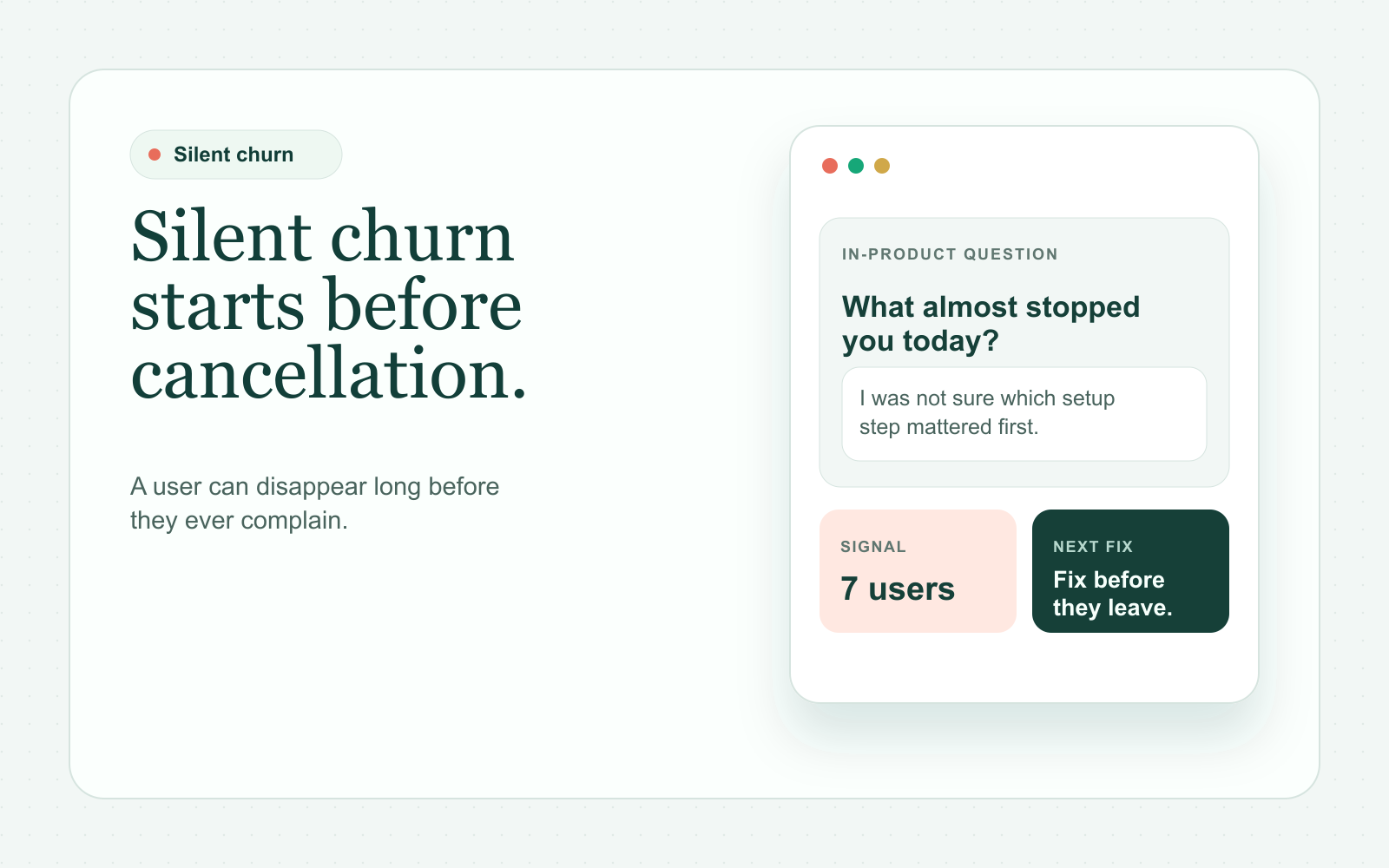
They sign up, click around, lose confidence, and vanish. No support ticket. No angry email. No cancellation note that explains the real problem. Just a trial account that never activates, a workspace that never invites a teammate, or a customer that slowly stops treating the product as part of their week.
From the dashboard, it looks like churn.
From the user’s side, it usually felt smaller than that. A few moments of doubt. A setup step that seemed heavier than expected. A promise that did not become clear quickly enough. A product that might have been useful, but never became obvious.
That is the quiet part of SaaS churn: many users leave before they care enough to complain.
Silence Is Not A Neutral Signal
Founders often interpret silence generously.
No tickets? Maybe the product is clear.
No complaints? Maybe onboarding is fine.
No cancellation feedback? Maybe the account was a bad fit.
Sometimes that is true. Often, silence means the user decided the product was not worth more effort.
This is especially common during the trial and early onboarding window. New users are still deciding whether to invest attention. They do not owe you a thoughtful explanation. They do not have a relationship with your team yet. If the product creates confusion before it creates value, leaving is easier than explaining.
A user who pays you $49 once may not feel entitled to complain. A trial user evaluating three tools this week may not bother to tell you why yours felt harder. A busy founder may not open support just to say, “I could not tell what to do next.”
They simply move on.
Silence does not mean the product experience was smooth. It may mean the product never earned enough trust for the user to speak up.
Churn Usually Starts As A Confidence Drop
Teams tend to think of churn as an event: the cancellation, the expired trial, the failed renewal, the inactive account.
But churn often starts earlier as a confidence drop.
The user sees an empty dashboard and cannot imagine the useful version. They reach an integration step and wonder if they need engineering help. They read plan limits and cannot tell which one matches their use case. They invite no one because they are not sure what teammates will see.
None of these moments feel dramatic. That is the problem.
They are small enough to ignore and important enough to change behavior.
A trial user who does not understand the first screen may still click around for a minute. An admin who feels uncertain about setup may still intend to return later. A product manager who does not see the value yet may keep the tab open for a day.
Then the week moves on.
By the time your metrics show non-activation, the useful question is no longer “Why did they churn?” It is “Where did they stop believing the next step was worth it?”
Analytics Shows The Drop. It Rarely Explains The Doubt.
Product analytics are essential. You should know where users drop off, what activation events correlate with retention, and which flows are underperforming.
But analytics can make a human problem look deceptively tidy.
A funnel can tell you that 58 percent of trial users never connect their first data source. It cannot tell you whether the step felt risky, technical, premature, poorly explained, or simply unrelated to the outcome that brought them in.
A session recording can show a user hovering over an integration page. It cannot tell you whether they were looking for security details, wondering about permissions, or deciding whether to ask an engineer.
A retention chart can show that activated users stick around. It cannot tell you why so many never believed enough to activate.
Silent churn lives in the gap between behavior and meaning.
That gap is where teams start guessing. Sales thinks the issue is pricing. Product thinks the issue is missing features. Marketing thinks the wrong users are signing up. Support has not heard anything, so the debate stays theoretical.
Meanwhile, the user may have had a very specific sentence in their head:
“I expected to see an example before connecting real data.”
“I was not sure what would happen if I invited my team.”
“This looked like more setup than I had time for.”
“I could not tell which result I was supposed to get first.”
Those sentences are gold. Most teams never capture them.
Users Do Not Report Every Moment Of Friction
Founders sometimes assume that real friction will produce feedback.
It will not.
Users report severe pain: broken billing, lost data, failed access, obvious bugs. But most SaaS friction is softer. It creates hesitation rather than outrage.
An unclear empty state does not usually trigger a support ticket. A vague onboarding step does not make someone angry. A dashboard with too many options can feel “not for me” before it feels broken.
This matters because early SaaS products often need feedback about precisely those softer moments. The product may not be failing because of one giant flaw. It may be leaking users through ten small uncertainties.
One screen asks for commitment too early.
One label uses internal language.
One checklist assumes the user knows the ideal order.
One trial experience shows every feature instead of the shortest path to value.
The user does not experience these as feedback items. They experience them as drag.
Drag is quiet.
Silent Churn Hides In Familiar Places
You can find silent churn by looking at the places where users showed intent but failed to build momentum.
The trial account that never returns
Someone signs up from a high-intent page, opens the product, and never comes back. The easy explanation is bad traffic. The more useful question is whether the first session gave them a fast reason to return.
Did they see value, or did they see work?
The onboarding step everyone postpones
If users repeatedly skip a setup step, do not only ask whether the step is too hard. Ask whether it is too early.
Many teams ask users to connect data, invite teammates, or configure rules before the user trusts the payoff. The friction is not the click count. It is the emotional order.
The feature opened once and abandoned
A feature that gets curiosity but no repeat usage may have a clarity problem. Users may understand that it exists without understanding why it matters, what good looks like, or how it fits into their workflow.
The support inbox that looks calm
A quiet support inbox can be good. It can also mean confused evaluators are leaving before they feel invested enough to ask.
Support volume is not a complete measure of product clarity.
How To Hear The Signal Earlier
The fix is not to bury users in surveys. That creates a different problem.
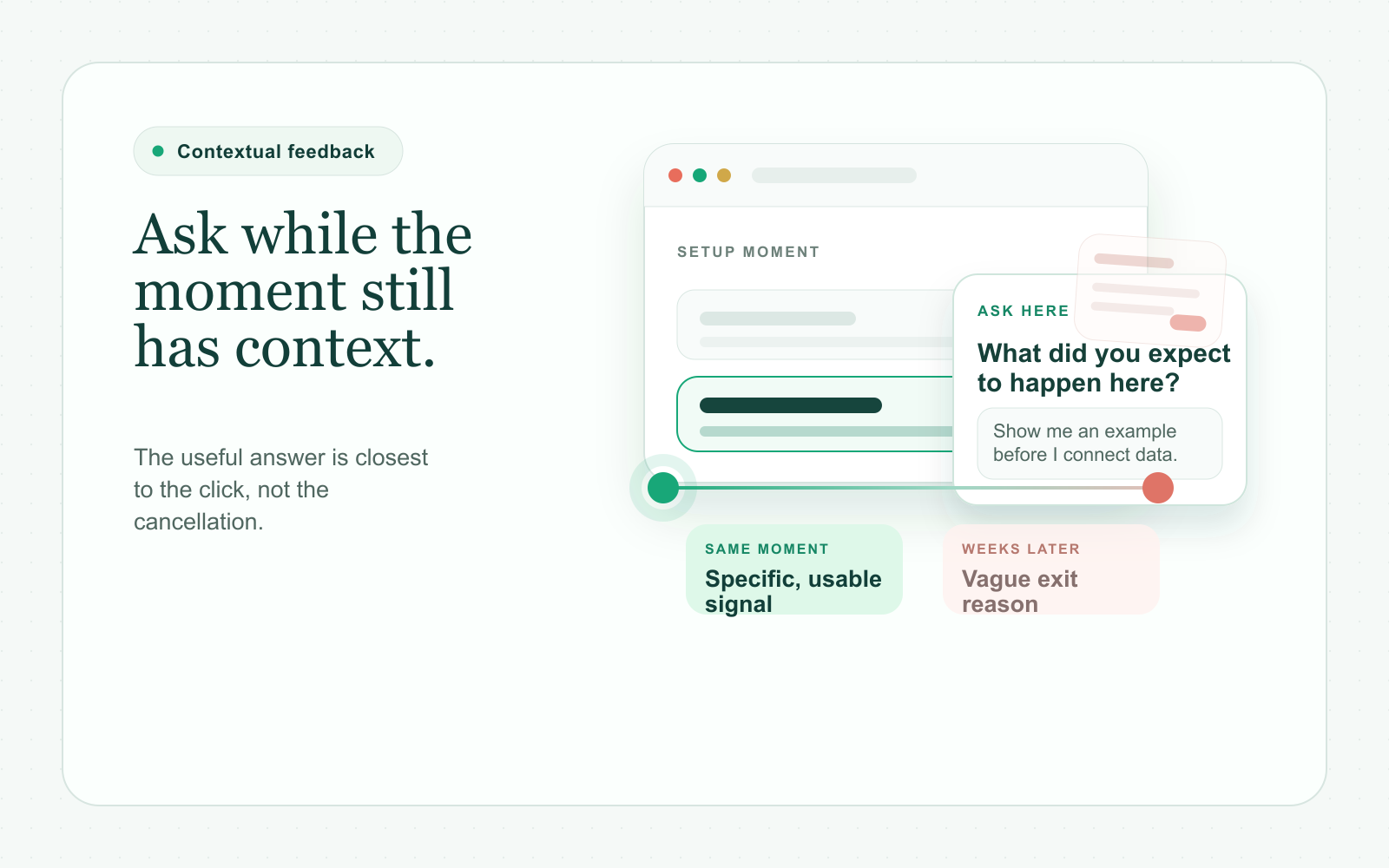
The fix is to ask smaller questions closer to the moment where doubt appears.
After signup, ask what the user expected to see first.
On a setup screen, ask what would make the step feel safe enough to finish.
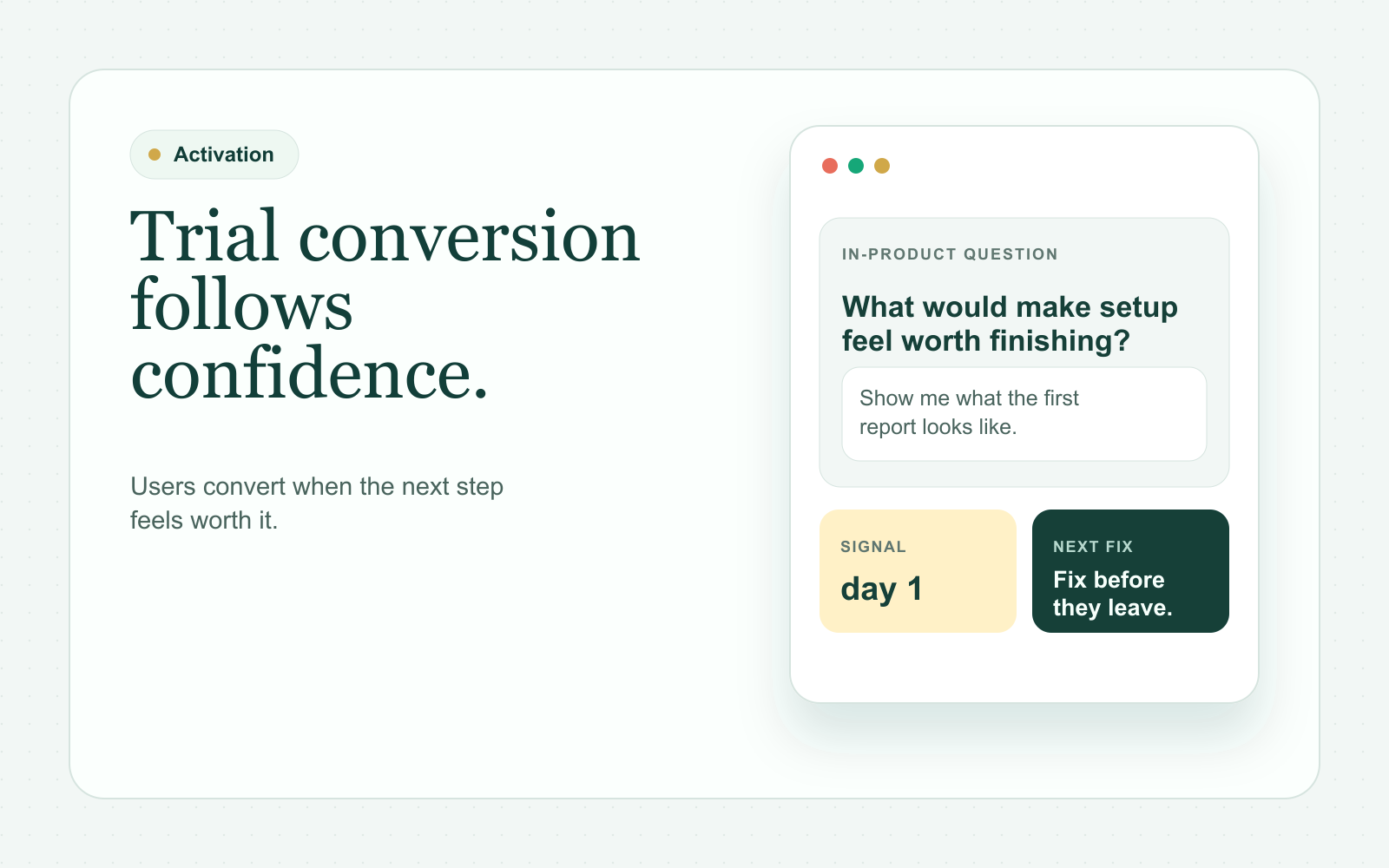
Near an empty dashboard, ask what example would help them understand the value.
After an inactive return, ask what they were hoping to continue.
The point is not to collect paragraphs. A single sentence can be enough if it explains why momentum stopped.
Strong questions sound like they belong in the moment:
- What almost stopped you from finishing setup?
- What feels unclear about this step?
- What did you expect to happen next?
- What would make this easier to trust?
- What were you trying to decide today?
These questions work because they respect the user’s context. They do not ask someone to summarize the whole relationship. They ask for the friction they can still remember.
The Best Fixes Are Often Smaller Than The Debate
Silent churn can make teams reach for big explanations.
Trial conversion is weak, so the team debates pricing. Activation is low, so the team adds features. Onboarding drops off, so the team plans a redesign.
Sometimes those moves are right. But often the first useful fix is smaller:
Add a sample state before asking for setup.
Explain what teammates will see before asking for invites.
Move the trust-building copy above the integration step.
Replace internal product language with the user’s words.
Show the first useful outcome instead of the full feature map.
Silent churn does not always mean the product is wrong. Sometimes it means users are carrying too much uncertainty too early.
Conclusion: Treat Quiet As A Clue
The angry user is not your only source of truth.
The quiet user may be telling you something too. They tell you through pauses, abandoned setup, one-session trials, unused features, and accounts that fade before they ever become urgent.
If you are building an early SaaS product, treat silence as a clue. Look for the moments where intent turns into hesitation. Ask while the memory is fresh. Use the user’s own words to find the small fixes that restore momentum.
ChimeIn is being built around that belief: know what to fix before users leave. If you want to help shape a lighter way to understand user friction before it becomes churn, join the ChimeIn waitlist.