Most SaaS Feedback Is Collected Too Late
Post-cancel surveys and late-stage feedback miss the freshest signal. SaaS teams need contextual feedback while product friction is still happening.
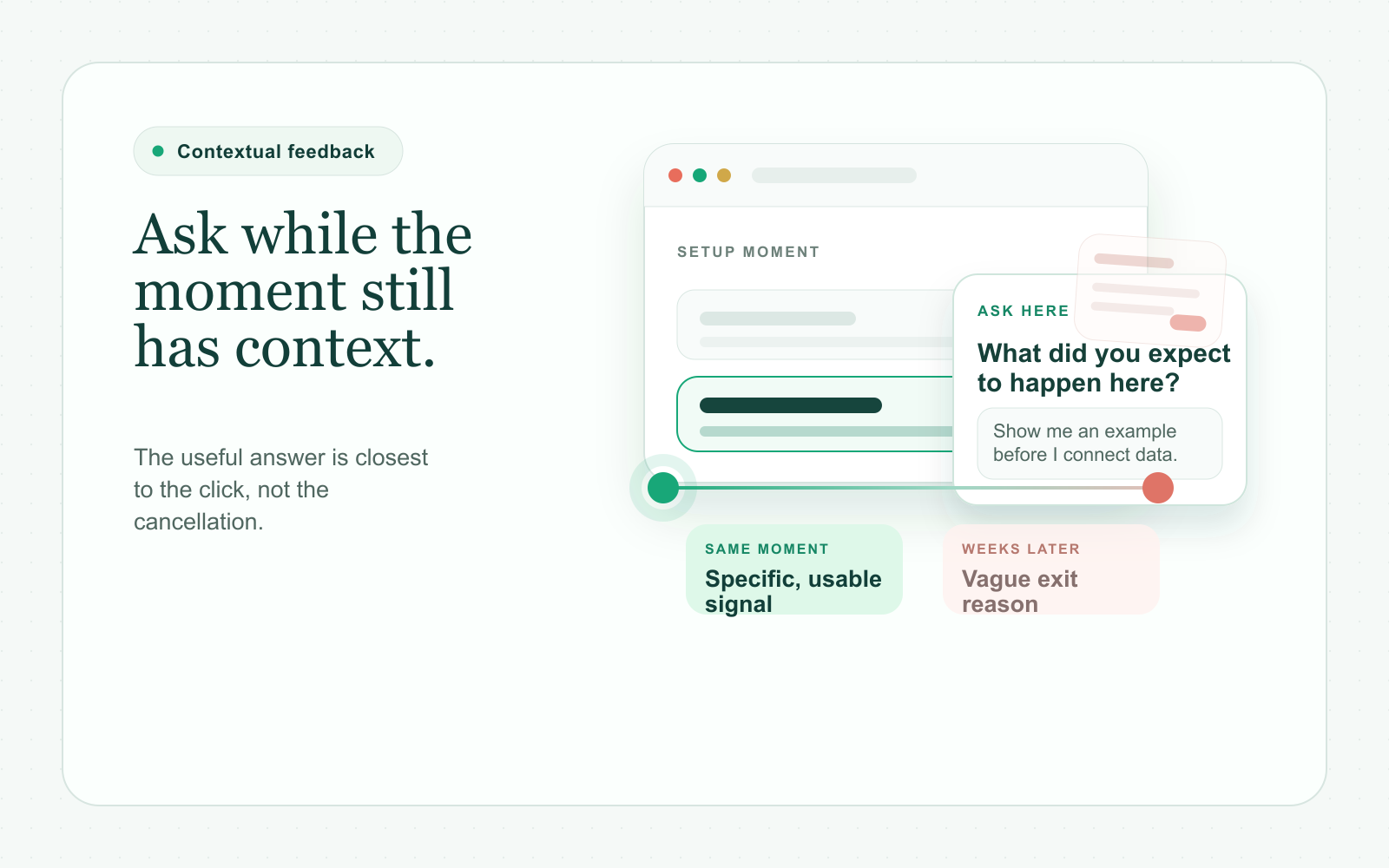
Most SaaS feedback arrives after the product moment that created it.
The user cancels, then gets a survey. The trial expires, then receives a “What stopped you?” email. The account goes inactive, then someone from the team asks for a call. A customer complains in support after they have already lost patience.
This is better than never asking. But it is still late.
Late feedback is usually a postmortem. The user has already made a decision, moved on emotionally, or compressed a messy experience into a tidy reason. You may learn what they are willing to say at the end, but you often miss what was true at the moment friction appeared.
That distinction matters.
If you ask after churn, you learn how people explain leaving.
If you ask during friction, you learn what made leaving more likely.
Feedback Decays With Time
Feedback has a half-life.
Right after a confusing setup step, the user can tell you exactly what felt unclear. Ten days later, they may only remember that the product “did not click.”
Right after seeing an empty dashboard, they know what they expected instead. At cancellation, they may choose “not enough value” from a dropdown.
Right before inviting a teammate, they can explain what feels risky. After the trial expires, they may not remember the invite screen at all.
This is not because users are careless. It is because people simplify experiences after the fact. Memory turns a series of product moments into a story that is easier to tell.
“Too expensive” can mean the user never reached enough value to justify the price.
“Missing features” can mean the feature existed but was hidden behind unclear navigation.
“Not a priority” can mean onboarding failed to create urgency.
“Went with another tool” can mean the other product explained the next step faster.
Late feedback is not useless. It is just filtered through distance.
The Cancellation Survey Is Not The Source Of Truth
Cancellation surveys are useful for spotting broad patterns. They can show that pricing confusion appears often, that a competitor is winning certain accounts, or that one segment churns for a different reason than another.
But they are a poor place to discover the original friction.
At cancellation, the user is trying to leave. They are not trying to help your roadmap. They have already justified the decision to themselves. They may choose the fastest answer, the politest answer, or the answer your form makes easiest.
Most cancellation surveys also strip away context.
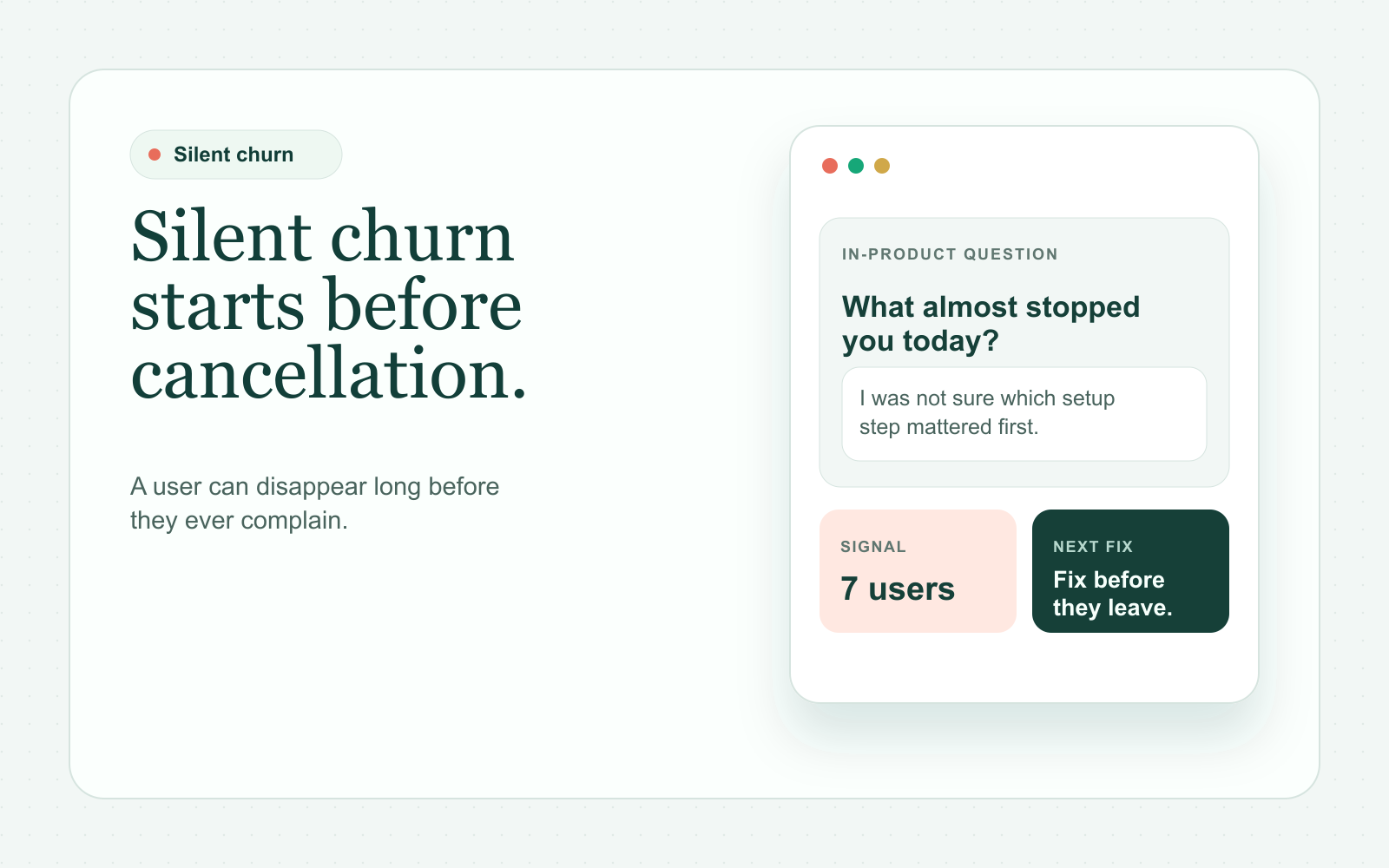
They do not know that the user abandoned setup after seeing an API key. They do not know that the user opened the reporting page three times but never found an example. They do not know that the user reached the billing page before activation, which makes “too expensive” much less informative.
The survey asks, “Why are you leaving?”
The better question may have been, “What made you hesitate here?”
And that question belonged much earlier.
Product Adoption Depends On Moments, Not Opinions
Generic feedback asks for opinions.
Contextual feedback asks about a moment.
That difference is the whole game.
“How satisfied are you with our product?” is broad. It forces the user to summarize too much.
“What felt unclear about this setup step?” is located. It invites a concrete answer.
“Would you recommend us?” may be useful later. It is not the right question for a user who has not reached activation.
“What were you hoping this dashboard would show first?” can reveal the expectation gap that prevents activation.
SaaS adoption is built from these small moments. The first screen. The first setup decision. The first empty state. The first team invite. The first report. The first time a user tries to explain the product to someone else.
If you only collect feedback after those moments have passed, you are asking users to reconstruct the path from memory.
Founders need the path while the footprints are still there.
Onboarding Is Where Late Feedback Hurts Most
Onboarding is not just a tutorial. It is the user’s first negotiation with your product.
They are asking:
- Is this worth my attention?
- Does this understand my problem?
- How much work will setup take?
- Can I trust this with real data or teammates?
- Will I see value soon?
If those questions stay unanswered, users do not always complain. They drift.
By the time you ask why they did not convert, the answer may sound vague: “We did not have time,” “It was not the right fit,” “We may revisit later.”
Those answers may be honest, but they are not precise enough to improve onboarding.
The precise answers were available earlier:
“I needed an example before connecting my CRM.”
“I did not know whether inviting a teammate would send an email.”
“The setup checklist started with the hardest step.”
“The dashboard was empty, so I could not tell what good looked like.”
Those are product insights. They can change copy, sequencing, empty states, defaults, trust language, and activation design.
Late feedback usually changes a spreadsheet.
Proactive Understanding Beats Reactive Collection
Reactive feedback collection waits until something goes wrong enough to be visible.
Proactive understanding looks for moments where user intent is high and certainty is fragile.
That could be after signup, when the user is comparing your product to the promise that got them in.
It could be during setup, when they are deciding whether the product deserves access, data, or team attention.
It could be after viewing an empty state, when they need help imagining the finished version.
It could be when they return after several quiet days, still interested but not yet committed.
The goal is not to interrupt every flow. The goal is to ask a small, useful question in the few places where the answer can explain product adoption.
Good timing makes feedback easier for the user too. They do not have to remember the whole trial. They only have to say what is true right now.
Better Timing Leads To Better Roadmap Choices
Late feedback can pull teams toward the loudest symptoms.
If churn surveys mention price, the team debates discounts. If sales calls mention missing features, the team adds scope. If power users request advanced controls, the product gets heavier.
All of that may be valid. But it can also distract from the adoption problem hiding underneath.
Maybe trial users are not converting because the price is wrong.
Maybe they are not converting because they never understood the value before seeing the price.
Maybe customers churn because a competitor has a feature you lack.
Maybe they churn because your product never became a weekly habit.
Maybe onboarding needs fewer steps.
Maybe it needs the same steps in a more trustworthy order.
You cannot answer those questions with late feedback alone.
You need feedback that is close enough to the product moment to explain what the user was trying to do, what they expected, and where confidence dropped.
What To Ask Instead
You do not need a massive research operation to improve timing. Start with the places where users already show intent.
After signup:
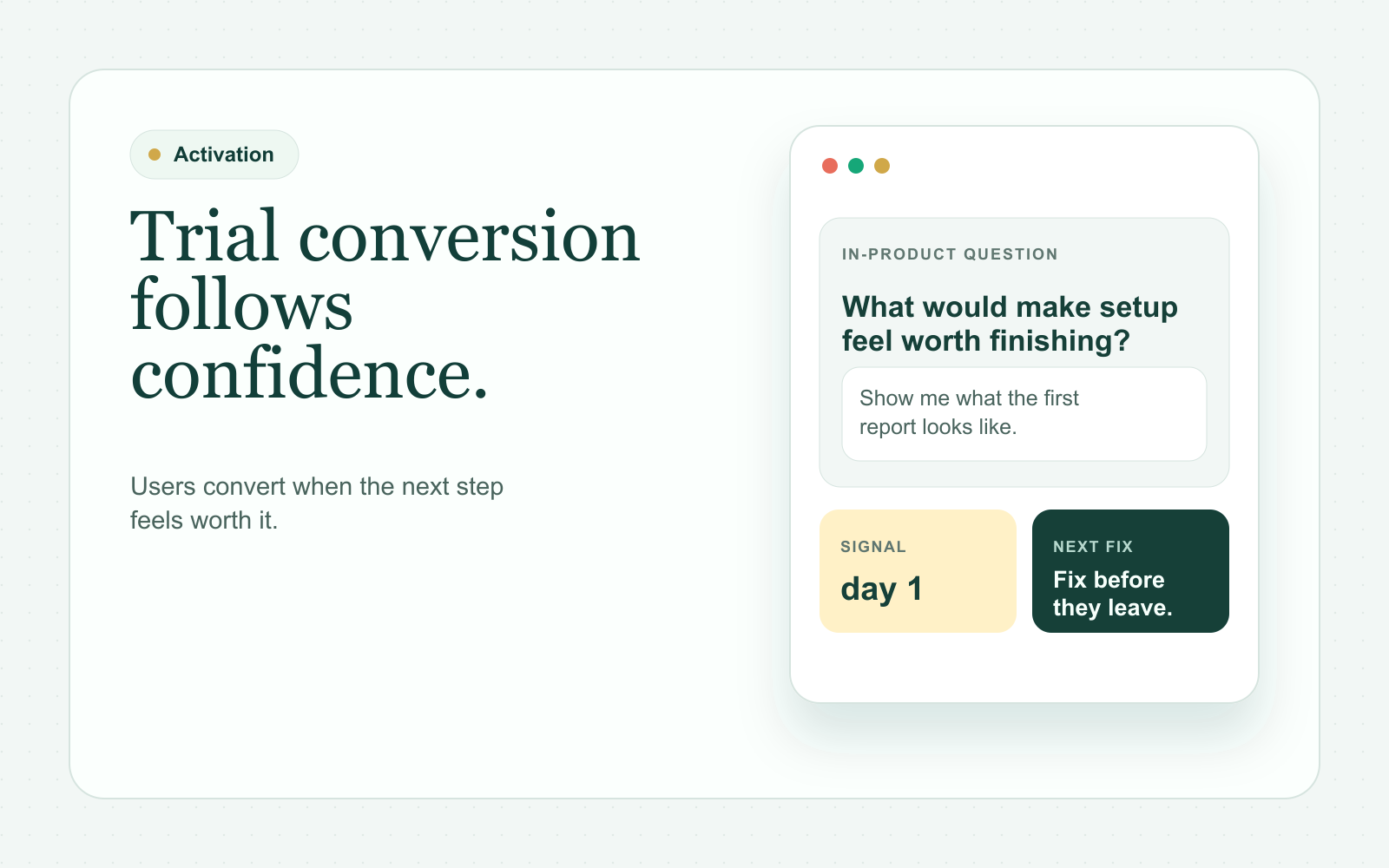
“What were you hoping to see first?”
During setup:
“What would make this step feel safe enough to finish?”
On an empty dashboard:
“What example would help you understand what this becomes?”
Before inviting teammates:
“What would you need to know before bringing your team in?”
After inactivity:
“What were you hoping to come back and finish?”
These questions work because they are specific without being leading. They give the user permission to be brief. They also produce language your team can act on.
If ten users say they need an example before connecting data, you may not need a new feature. You may need a sample state.
If five users hesitate before inviting teammates, you may not need better collaboration tools. You may need clearer permission copy.
If trial users say the dashboard does not tell them where to start, you may not need more analytics. You may need a stronger first action.
Make Feedback Part Of The Product Rhythm
The real challenge is not collecting more comments. It is building a habit that turns feedback into decisions.
Small SaaS teams do not have time for a bloated research system. They need a rhythm that helps them see what users care about, what friction is hurting activation or retention, and what should be fixed next.
That means feedback should be:
- close to the moment
- easy for the user to answer
- grouped into patterns the team can review
- tied to product decisions, not stored as decoration
The best feedback system is not the one with the most responses. It is the one that helps the team make a better call this week.
Conclusion: Ask While The Signal Is Alive
If you only ask after churn, you mostly learn how users explain a decision they already made.
If you ask closer to friction, you learn what made the product harder to adopt in the first place.
That is a better input for onboarding, activation, retention, and product adoption. It also respects the reality of early-stage SaaS: founders need sharper signal, not more noise.
ChimeIn is being shaped around this idea: know what to fix before users leave. If you want to help build a lighter way to catch contextual user feedback while it still matters, join the ChimeIn waitlist.